
45 Frugal Living Tips to Save Money Every Month

This post may contain affiliate links. If you buy through them, I may earn a small commission at no extra cost to you. Read our full affiliate disclosure
Have you ever watched a tap that won’t stop dripping? One drop looks like nothing. Leave a bucket under it overnight, and in the morning it’s full.
That is how I think about frugal living. No single tip on this list will change your life on its own.
But small habits, repeated every month, quietly fill the bucket until one day you have real breathing room.
Below are 45 frugal living tips I actually use or learned the hard way, plus a few researched ones that work for most households. You don’t need all of them. Pick five, make them automatic, then come back for five more.
Quick Look: Why Small Savings Matter
According to the Federal Reserve’s latest report on household well-being, 63% of U.S. adults said they would cover a surprise $400 expense with cash or its equivalent. That means more than a third would need to borrow, sell something or simply couldn’t pay.
A $400 surprise is a car repair, a vet bill or one bad month. The goal of the tips below is simple: make sure that when it comes, you have a bucket to dip into.
The short version: Plan your budget before the month starts, save a fixed amount first, plan your meals weekly, buy household basics in bulk, cut waste at home, walk when you can, and repair before you replace.
My Story: The Day I Had Money but Couldn’t Reach It
When I moved to a big city for college, I had never managed money on my own. Until then, my family handled everything. I didn’t know what rent, food or transport really cost, and I definitely didn’t know how to budget.
So I spent like someone who had never seen a bill. I ate most meals outside, breakfast and dinner included. I bought things I didn’t need.
Then one day I checked and realized I had only a few coins left. My father transferred money to my account, and I felt relieved. But at the ATM, I was so stressed that I entered the wrong PIN three times. My account was blocked for 24 hours.
That day, all I could afford was a loaf of bread and a bottle of water. There was no friend I could ask, and nobody to call who could fix it fast. I sat with that bread and thought about every meal I had eaten outside and every unnecessary thing I had bought for myself in those first weeks.
That was my turning point. I started planning my money before each month began. I learned to cook.
I tracked every purchase. And I began saving a fixed amount every month, even when it was tiny, because I never wanted to feel that helpless again.
Every tip below comes from that lesson or from research that backs it up.
How to Use This List
Forty-five tips can feel like a lot. Here’s a simple way to make it manageable:
• Week 1: Start with tips 1 to 5. They set up the system everything else depends on.
• Week 2: Pick three food tips. Food is usually the fastest place to save.
• Week 3: Pick three home or transport tips.
• Week 4: Pick two spending habits and one mindset tip.
By the end of the month, you’ll have a dozen new habits without feeling deprived.
Part 1: Plan Your Money Before the Month Starts (Tips 1–8)
1. Make your budget before the month begins
This is the habit that changed everything for me. A few days before each month starts, I sit down and decide where every dollar will go. Budgeting after the month begins means you’re always reacting to money that’s already gone.
Write down your take-home pay, your fixed bills and your goals. Then give the rest a job before you spend a cent.
2. Use the 50/30/20 rule as your framework
I follow the 50/30/20 rule, popularized by Elizabeth Warren and Amelia Warren Tyagi in their book All Your Worth. It splits your take-home pay into three simple buckets:
• 50% needs: housing, utilities, groceries, transportation, insurance and minimum debt payments.
• 30% wants: eating out, entertainment, hobbies, subscriptions and non-essential shopping.
• 20% savings and debt: your emergency fund, extra debt payments and retirement savings.
It’s not a strict law. If your rent is high, your needs might take 60% for a while. The point is to have a target, so you notice when wants start eating into savings.

Enter your monthly take-home pay below to see your own 50/30/20 split:
50/30/20 Budget Calculator
Enter your monthly take-home pay (after taxes) to see how much goes to needs, wants and savings.
Needs: housing, utilities, groceries, transport, insurance, minimum debt payments. Wants: eating out, entertainment, subscriptions, shopping. Weekly figures use 52 weeks a year.
3. Pay yourself first with a fixed monthly savings amount
I set a fixed savings amount every month and move it before I spend on anything else. Not "whatever is left at the end," because there is rarely anything left at the end.
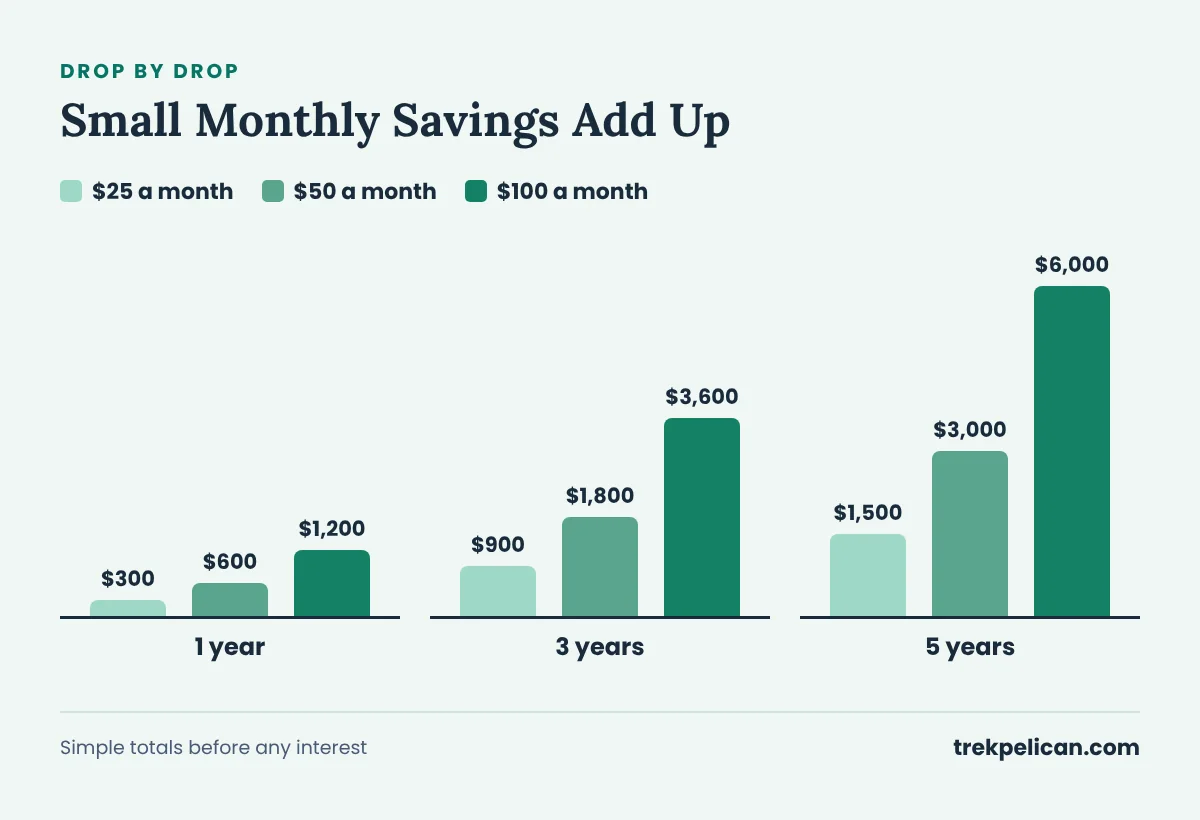
Even a small amount counts. It might look tiny today, but over time it becomes enough to handle an emergency. That is the dripping tap filling the bucket.
4. Build an emergency fund, drop by drop
Most experts suggest eventually saving three to six months of expenses. That number can feel impossible at first, so don't start there. Start with a first goal of $400, then one month of expenses, then keep going.
Keep it in a separate savings account so you don't spend it by accident. If I'd had even a small cushion in my college days, that bread-and-water day would have been a minor annoyance instead of a scary one.
5. Budget for food first
Food is the first need for survival, so it's the first line in my budget. Before anything else, I estimate what I'll spend on groceries for the month.
Once food is covered, I move on to transport, phone, study or work costs and everything else. If money gets tight, at least the most important thing is already protected.
6. Write down every purchase as you make it
Whenever I buy something, I note it down right away with the price. A notes app, a small notebook or a spreadsheet all work. The method matters less than doing it every time.
Tracking in the moment is powerful because you can't hide from small purchases. That daily coffee or snack shows up on the page, and you start asking whether it's worth it.
7. Work out your daily cost, then your monthly cost
Here's a trick that made my budgeting much more accurate. I estimate what one day of food costs me, then multiply it to get a monthly figure. I do the same each week by adding up what I actually bought.
Daily numbers are easier to picture than monthly ones. "I spend about $8 a day on food" is something you can manage. "I spend $240 a month" feels abstract until it's gone.
8. Do a 15-minute weekly money check
Once a week, compare what you planned with what you spent. Are you on track for groceries? Did a want sneak into the needs column?
Small corrections each week stop a bad month before it happens. It's much easier to adjust by $20 on day 8 than by $200 on day 30.
Part 2: Food and Groceries (Tips 9–18)
9. Plan your meals for the whole week
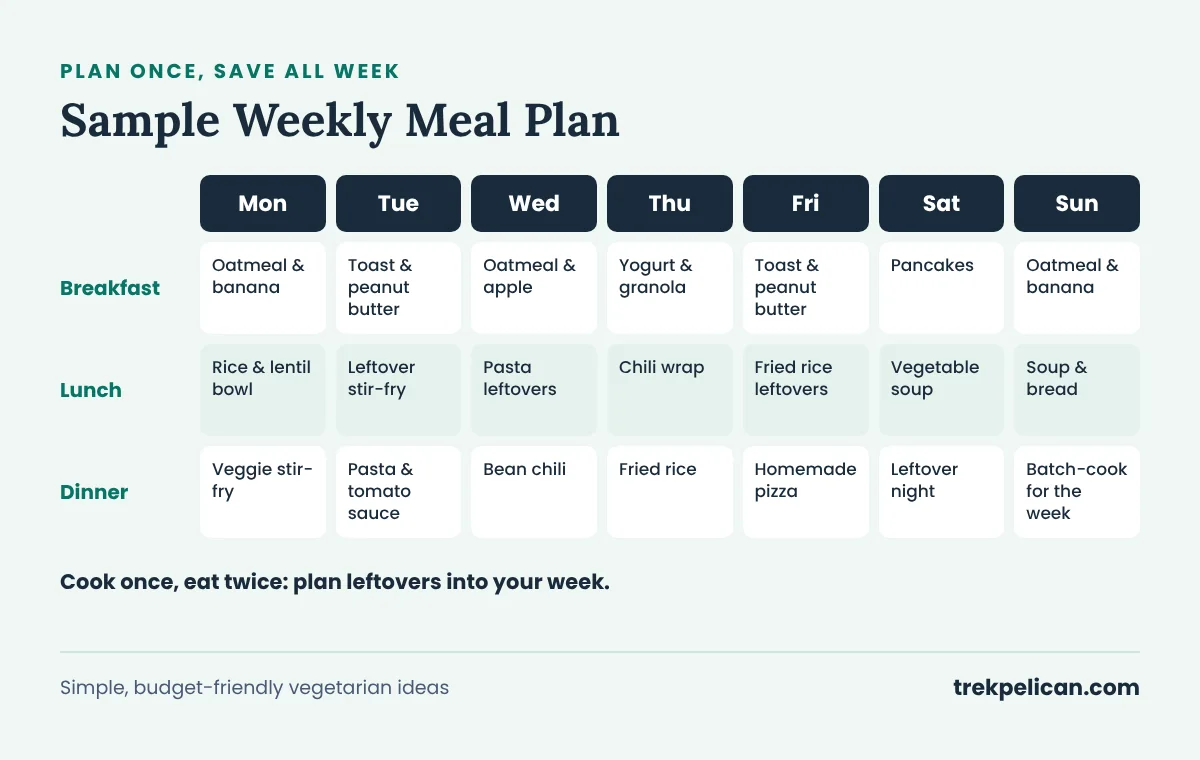
This is the tip I recommend to everyone. Every week I write a simple plan: Monday breakfast, lunch and dinner, then Tuesday, then Wednesday, and so on. It takes 15 minutes and saves money all week.
A meal plan stops the daily "what should I eat?" moment that usually ends with ordering food. It also means you buy only what you'll actually cook.
10. Learn to cook a handful of basic meals
When I started college, I ate breakfast and dinner outside almost every day. Once I learned to cook for myself, my monthly food cost dropped by roughly three-quarters. That was the single biggest saving I ever made as a student.
You don't need to be a chef. Learn five cheap, filling meals you enjoy, like a lentil soup, a vegetable stir-fry, a pasta dish, a rice bowl and a hearty breakfast. Rotate them, and you're set.
11. Never shop without a list
Your meal plan becomes your grocery list. Stick to it and you'll avoid the "it looked good" purchases that add up fast. If you're tempted, ask whether it's on the list. If not, it waits until next week.
12. Buy staples in bulk
Rice, oats, beans, lentils, flour, pasta and cooking oil keep for a long time and are often cheaper per unit in larger packs. Buy them when you have the cash and space, and your weekly shop gets smaller.
13. Compare unit prices, not package prices
The shelf label usually shows a price per ounce or per pound. A bigger box isn't always cheaper per unit, and a sale price isn't always the best deal. A quick glance at the unit price helps you choose the real bargain.
14. Swap expensive items for cheaper ones in a tight week
When certain vegetables or fruits get expensive, I simply skip them and buy what's cheaper and in season. Frozen vegetables are a great swap too, since they're picked at peak and often cost less than fresh.
Flexibility beats loyalty to a specific item. Cook around what's affordable this week.
15. Cook in batches and plan for leftovers
Cooking a big pot once and eating it two or three times saves time, energy and money. Plan "leftover nights" into your weekly menu so nothing goes to waste.
16. Freeze food before it spoils
The USDA estimates that 30 to 40% of the U.S. food supply goes to waste. Every item you throw away is money in the bin.
Freeze bread, cooked rice, ripe bananas, chopped vegetables and extra portions before they turn. Keep older food at the front of the fridge so you use it first.
17. Pack your lunch and carry your own water
Buying lunch and bottled drinks every day is one of the quietest budget leaks. A packed lunch and a reusable water bottle can easily save more than most people expect over a month.
18. Make eating out a planned treat, not a habit
I still enjoy eating out sometimes. The difference is that it's planned and budgeted in the "wants" column, not an everyday default. Planned treats feel better, too, because there's no guilt afterward.
Part 3: Household Essentials (Tips 19–24)
19. Stock up on essentials all at once
I buy soap, detergent, toothpaste, shampoo, hair oil and cooking basics in larger quantities, once a month. That way, I'm not rushing to the store every few days.
Fewer trips mean fewer impulse buys. Every extra visit to a store is another chance to walk out with things you didn't plan to buy.
20. Buy when there's an offer, but only what's on your list
I shop at big stores and online because I often get lower prices and occasional offers. Sales help a lot for things you need anyway, like toiletries and cleaning supplies.
The rule is simple: an offer is only a saving if the item was already on your list. Otherwise, it's just spending with a discount sticker on it.
21. Choose store brands for basics
Store brands for things like salt, flour, cleaning products and paper towels are often just as good as name brands and noticeably cheaper. Try one swap at a time and keep the ones you don't notice a difference with.
22. Use less of each product
Most of us use more detergent, shampoo and dish soap than we need. Follow the measured dose on the label, or try a little less. Your products last longer and the results are usually the same.
23. Make simple cleaners at home
White vinegar, baking soda and dish soap can handle a surprising amount of everyday cleaning. A homemade all-purpose spray costs pennies compared with a cabinet full of special products. Never mix vinegar or other cleaners with bleach.
24. Keep a household "running low" list
Stick a list on the fridge or keep one on your phone. When something runs low, add it. Then buy everything in one planned trip instead of making emergency runs that usually include extras.
Part 4: Home and Utility Bills (Tips 25–31)
25. Switch off fans and lights the moment you leave a room
This one sounds obvious, but it's a habit I still follow strictly. If nobody's in the room, the fan and lights go off. Small amounts every day add up on a monthly bill.
26. Use daylight whenever you can
During the day, I read by an open window instead of switching on lights, or I go to a quiet, bright place like a library. Natural light is free, and it's easier on your eyes too.
27. Unplug devices on standby
Chargers, TVs, game consoles and microwaves keep drawing power even when they're "off." Research from Lawrence Berkeley National Laboratory has estimated standby power at about 5% of household electricity, and up to 10% in some homes.
Plug electronics into a power strip and switch it off at night or when you leave.
28. Switch to LED bulbs
According to the U.S. Department of Energy, LED bulbs use at least 75% less energy than incandescent bulbs and can last up to 25 times longer. Replace bulbs as they burn out, starting with the lights you use most.
29. Wash full loads in cold water
Most of a washing machine's energy goes into heating water. Washing in cold water and running only full loads cuts that cost. Air-drying clothes when you can saves even more.
30. Adjust your thermostat a few degrees
A couple of degrees lower in winter and higher in summer makes a noticeable difference over a month. Layer up, use a blanket and close curtains at night to keep heat in.
31. Pick a phone plan that matches how you actually use it
I budget for my phone plan every month, including calls and data, and I choose a plan that fits my real usage. Check how much data you use over a few months. Many people pay for far more than they need, and prepaid or smaller carriers can cost much less.
Part 5: Getting Around (Tips 32–35)
32. Walk short distances
If somewhere is walkable, I walk. It saves fuel or fares and it doubles as free exercise. In college, my walk to campus took about an hour, so I didn't do it every day, but on light days it saved real money.
33. Choose public transport over cabs
For my college commute, I mostly took the bus and saved cabs for when they were truly needed. Public transport is usually far cheaper per trip, and monthly passes can lower the cost further. Budget your transport cost before the month starts so you know what you can afford.
34. Combine your errands into one trip
Plan your errands so you do several in one outing. Fewer trips mean less fuel, fewer fares and fewer chances to stop for an unplanned coffee or snack.
35. Share rides when you can
Carpooling with coworkers or classmates splits costs and makes the commute more pleasant. Even sharing one or two trips a week adds up over a year.
Part 6: Smarter Spending Habits (Tips 36–41)
36. Repair or reuse before you replace
Before buying something new, I always ask whether I can fix it or use it differently. A loose button, a broken zip or a wobbly chair leg is often a five-minute fix. Online repair videos make it easier than ever.
37. Use a waiting rule for non-essentials
For anything you want but don't need, wait. I suggest 48 hours for small items and 30 days for bigger ones. Write it on a list. Most of those urges fade, and the ones that remain are things you'll truly value.
38. Buy used for big items
Furniture, bikes, tools, textbooks and baby gear are often available second-hand in great condition for a fraction of the price. Check local marketplaces and thrift stores before buying new.
39. Cancel subscriptions you don't use
Go through your bank and card statements and list every recurring charge. Cancel what you don't use, and pause what you only use sometimes. You can always restart later.
40. Don't be the one who always pays
I learned this one painfully in college. Treating friends and family feels generous, but covering everyone’s food or outings every time adds up quickly. Splitting the bill is normal, and real friends won’t mind.
Be generous when your budget allows it, not because you feel pressure in the moment.
41. Use cashback and coupons only on planned purchases
Cashback, coupons and price-comparison tools are great when you're buying something you already planned to buy. They become a trap when they convince you to buy things you didn't need. Plan first, then look for the deal.
Part 7: Frugal Mindset (Tips 42–45)
42. Find free fun
Parks, libraries, community events, free museum days, home movie nights and long walks cost nothing. A fun weekend doesn't need a big bill. Make a list of free things nearby and pull it out whenever you're bored.
43. Know what not to be frugal about
Frugal doesn't mean cheap. I don't cut corners on health, safety, good tools or learning new skills. A cheap item that breaks quickly ends up costing more than a good one bought once.
44. Always keep a backup way to reach your money
My bread-and-water day taught me this. Keep a small amount of emergency cash at home, know your PIN well enough that stress won't make you forget it, and if possible have a second card or account. One locked card shouldn't leave you stranded.
45. Save the difference and celebrate small wins
Whenever a tip saves you money, move that amount straight into savings. If you cooked instead of ordering in, transfer what the takeout would have cost. Seeing the balance grow makes frugal living feel rewarding, not restrictive.
Curious how far those small savings can go? Try the calculator below:
Drop-by-Drop Savings Calculator
See how a small amount saved every month adds up over time.
Interest is an estimate, compounded monthly. Savings rates change, so check your bank's current rate.
Top 10 Frugal Tips If You Only Do a Few
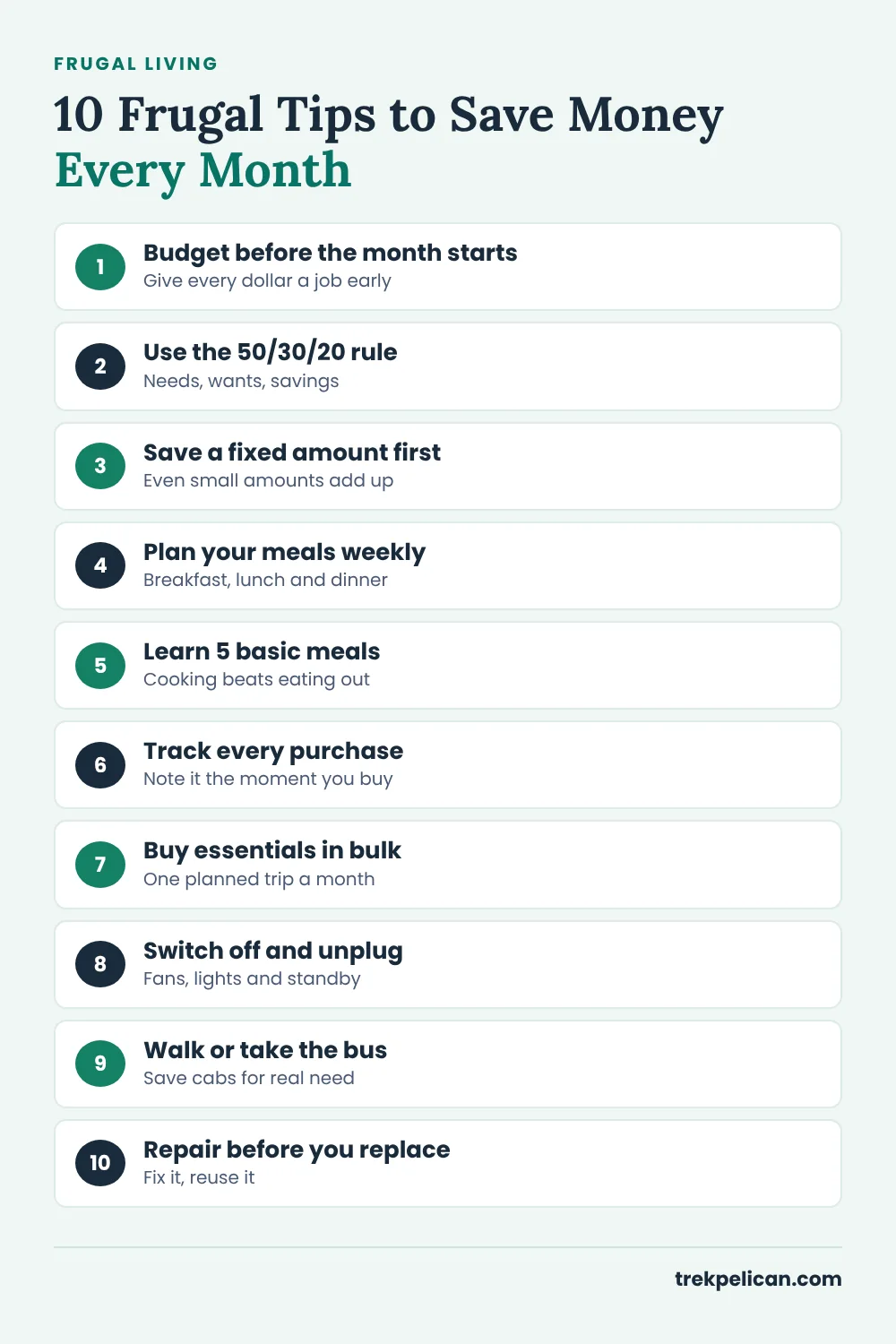
1. Make your budget before the month starts.
2. Follow the 50/30/20 rule as a guide.
3. Save a fixed amount first, every month.
4. Plan your meals for the week.
5. Learn to cook five basic meals.
6. Track every purchase as you make it.
7. Buy household essentials in bulk, once a month.
8. Turn off fans, lights and standby devices.
9. Walk or take public transport when you can.
10. Repair or reuse before you replace.
Common Frugal Living Mistakes to Avoid
• Trying all 45 tips at once. You'll burn out. Add a few habits at a time.
• Buying cheap things that break fast. Paying a little more for durability often saves money over time.
• Saving "whatever is left." There's rarely anything left. Save first.
• Buying in bulk without a plan. Bulk only saves money if you actually use it before it spoils.
• Cutting all fun. A small budget for treats keeps you consistent.
• Keeping savings in your everyday account. Separate it so you don't spend it by accident.
Free and Paid Tools to Help You Save
If you want a simple way to put these tips into practice, I made two printables you can fill in on screen.
FREE: January Money Reset 30-Day Tracker
Includes a one-month survival budget, a subscription audit, a "not this month" list and a 30-day no-spend checklist. Free to download, no signup needed.
Download the free tracker →Holiday-Proof Money Planner
A 44-page fillable planner with 12 monthly budget pages, a weekly expense tracker, a cut-back plan, a side income log and sinking fund trackers for every big expense.
Get the Holiday-Proof Money Planner →Helpful Books and Tools for Frugal Living
These books and simple tools make saving easier:
• The Complete Tightwad Gazette by Amy Dacyczyn – a classic collection of practical money-saving ideas for every part of the home. Check price
• Budget Bytes by Beth Moncel – a cookbook of tasty, low-cost recipes, perfect for learning to cook on a budget. Check price
• Good and Cheap by Leanne Brown – simple, filling meals designed for very tight food budgets. Check price
• All Your Worth by Elizabeth Warren and Amelia Warren Tyagi – the book behind the 50/30/20 budget rule. Check price
• Glass meal prep containers – make batch cooking and packed lunches easy. Check price
• Reusable insulated water bottle – stop paying for bottled drinks. Check price
• LED light bulbs (multi-pack) – lower your lighting bill as old bulbs burn out. Check price
• Smart power strip – cut standby power with one switch. Check price
Frequently Asked Questions
What is the best frugal living tip for beginners?
Make a budget before the month starts and save a fixed amount first. Those two habits create the system every other tip depends on.
How much money can frugal living save each month?
It depends on your starting point. Food is usually the biggest opportunity. Cooking at home instead of eating out cut my food spending by roughly three-quarters. Smaller habits like canceling subscriptions and cutting standby power add more on top.
Does the 50/30/20 rule work on a low income?
Yes, as a guide. If needs take more than 50% of your income, that's normal for many people. Shrink wants first, keep some amount going to savings, even if it's less than 20%, and adjust as your income grows.
How do I start an emergency fund with very little money?
Start small and make it automatic. Set a fixed amount, even $10 or $20, to move into a separate savings account each payday. Aim for $400 first, then one month of expenses.
Is frugal living the same as being cheap?
No. Being frugal means spending intentionally on what matters and cutting waste. Being cheap means always choosing the lowest price, even when it costs more over time or hurts other people.
How do I stick to a weekly meal plan?
Keep it simple. Rotate five or six meals you enjoy, plan one leftover night, and shop only from the list your plan creates. Prep a few ingredients on the weekend to make weeknights easier.
Final Thoughts: One Drop at a Time
I still remember sitting with that loaf of bread, wishing I had been more careful. That day taught me that money problems usually come from small habits, not one big mistake. Good news: the fix works the same way.
Plan your month before it starts. Save first, even if it's small. Cook more, waste less, walk when you can and fix before you replace. One drop at a time, the bucket fills.
If you overspent recently and need a step-by-step plan, read my guide on how to recover financially after the holidays. And if you want to grow your income alongside your savings, see how I make $100 a day blogging.
For more frugal living and budgeting ideas, follow Trek Pelican on Pinterest.
Sources
• Federal Reserve – Report on the Economic Well-Being of U.S. Households: Unexpected Expenses
• InCharge Debt Solutions – The 50/30/20 Rule for Budgeting
• Lawrence Berkeley National Laboratory – Pulling the Plug on Standby Power
• U.S. Department of Energy – Guide to Energy-Efficient Lighting