
The 50/30/20 Budget Rule Explained With a Real Example (And Where It Breaks Down)
This post may contain affiliate links. If you buy through them, I may earn a small commission at no extra cost to you. Read our full affiliate disclosure
Most budgets fail for a simple reason: they ask you to track too much. Twenty categories, a spreadsheet with color codes, an app that sends you alerts. By the second week, you’ve stopped looking.
The 50/30/20 rule works because it asks for only three numbers.
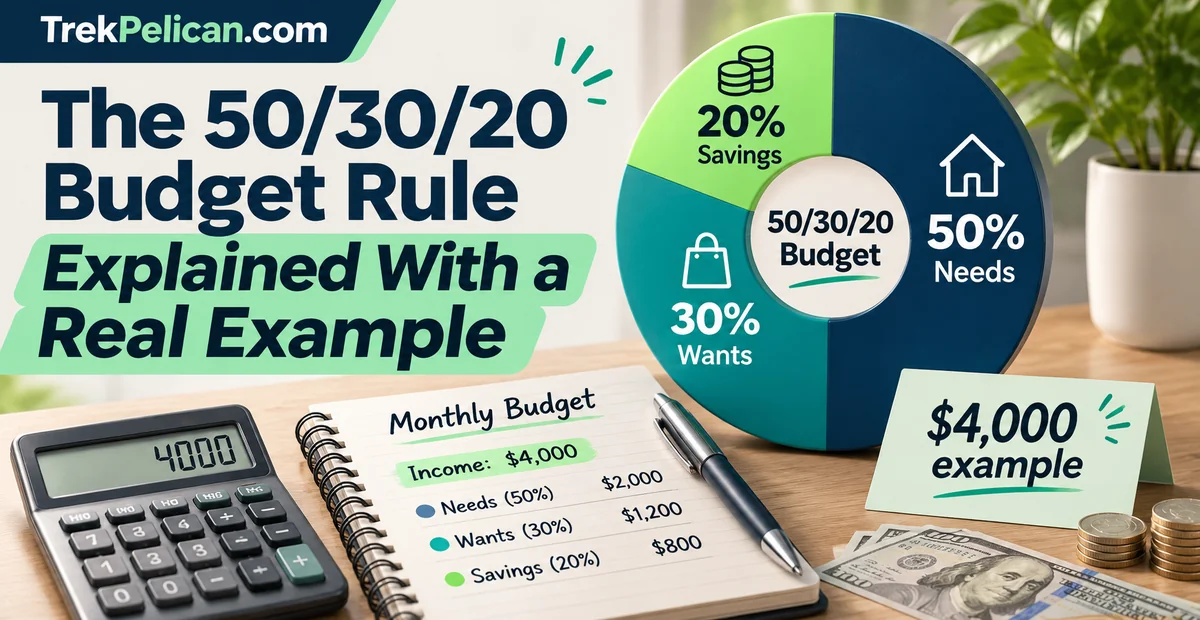
Half of your take-home pay goes to needs, 30% to wants and 20% to savings. That’s the whole system.
I’ve followed this rule since I started earning properly, and it’s still the backbone of how I plan every month. But I’ve also seen exactly where it bends and where it breaks. In this post, I’ll walk you through a real month with rounded numbers, show you how I set it up, and explain what to do when the percentages stop fitting your life.
Take your monthly take-home pay. Put 50% toward needs, 30% toward wants and 20% toward savings or extra debt payments. Move the 20% first, the day money arrives. If your needs are bigger than half your income, change the split instead of giving up on the budget.
What the 50/30/20 Rule Is
The 50/30/20 rule splits your after-tax income into three buckets. It was popularized by Elizabeth Warren and her daughter, Amelia Warren Tyagi, in their 2005 book All Your Worth: The Ultimate Lifetime Money Plan. Twenty years later, it’s still one of the most recommended starter budgets because it’s so easy to remember.
Here’s what each bucket covers:
• 50% for needs: the bills you must pay to live and work. Rent or mortgage, utilities, groceries, transport, insurance, basic phone and internet, and minimum debt payments.
• 30% for wants: everything that makes life enjoyable but isn’t essential. Eating out, shopping, streaming, hobbies, trips and gifts.
• 20% for savings and goals: your emergency fund, other savings goals, retirement contributions and any debt payments above the minimum.
Why it uses take-home pay, not your salary
The rule is based on what actually lands in your bank account after taxes and payroll deductions. If your salary is $60,000 a year, you won’t have $5,000 a month to split. After taxes, your take-home pay might be closer to $4,000.
Budgeting from your gross salary is one of the fastest ways to break this rule. Every bucket looks bigger on paper than it really is, and by the end of the month the numbers don’t add up.
If your employer takes retirement contributions out before your paycheck arrives, you can count those toward your 20%. They’re still savings, even if you never see the money.
Needs vs. Wants: Where Most People Get It Wrong
The math of 50/30/20 is easy. The hard part is being honest about which bucket an expense belongs in. Many wants quietly sneak into the needs column, and that makes it look like your needs take far more than 50%.
Here’s how I sort the most common gray-area expenses:
| Expense | The need part | The want part |
|---|---|---|
| Food | Groceries for home-cooked meals | Restaurants, takeout, coffee runs |
| Phone | A basic plan that works | The newest phone, premium data |
| Internet | A plan fast enough for work or study | The top-speed upgrade |
| Transport | Getting to work, school and stores | Cabs when the bus works fine |
| Clothing | Replacing worn-out basics | New outfits for fun |
| Housing | A safe, reasonable place to live | The extra room or the trendier area |
| Fitness | Walking, home workouts | Gym membership, classes |
A simple test for any expense
Ask yourself: “If I lost my income next month, would I still pay for this?” If the answer is yes, it’s probably a need. If you would cancel it or cut it back, it’s a want, or at least partly a want.
Splitting an expense is completely fine. If your phone bill is $80 and a basic plan costs $40, count $40 as a need and $40 as a want. That one habit makes your budget far more honest.
How I Came to Use the 50/30/20 Rule
I didn’t start with a budgeting rule. In college, I lived on a fixed amount of money each month that had to cover everything, from rent to daily essentials. After one painful early mistake, there was no extra money coming, so I had to make that amount work.
My only system back then was simple: food first. As soon as my money arrived, I set aside what I needed for food before anything else, and whatever I didn’t spend slowly turned into savings. I’ve shared that full story in my posts on frugal living tips and building an emergency fund by saving the same amount every month.
When I started earning properly, I came across the 50/30/20 rule, and it fit what I was already doing. It gave me clear percentages instead of “whatever I could manage.” Needs still came first, but now savings had a fixed share too.
That’s still how I budget today. My income comes from several places, including blogging, Facebook and digital products, but every month gets the same three buckets.
A Real Example With Rounded Numbers
Here’s a full month on a take-home income of $4,000. I’ve rounded every number so the math is easy to follow. Your own amounts will be different, but the structure works the same way at any income.
On $4,000, the rule gives you three targets:
• Needs (50%): $2,000
• Wants (30%): $1,200
• Savings (20%): $800
Needs: $2,000
| Need | Monthly amount |
|---|---|
| Rent | $1,200 |
| Groceries | $350 |
| Utilities | $150 |
| Transport | $150 |
| Phone and internet (basic) | $100 |
| Insurance | $50 |
| Total | $2,000 |
Notice that rent alone takes 30% of take-home pay here. That’s normal, and it’s why the needs bucket fills up quickly. If rent were $1,500, this budget would already be over 50% before groceries.
Wants: $1,200
| Want | Monthly amount |
|---|---|
| Eating out and takeout | $250 |
| Shopping and personal items | $200 |
| Trips and travel fund | $200 |
| Hobbies and entertainment | $150 |
| Gifts and occasions | $150 |
| Subscriptions | $50 |
| Flexible spending | $200 |
| Total | $1,200 |
The “flexible spending” line matters more than it looks. It’s room for the small things nobody plans for, like a coffee with a friend or a last-minute birthday card. Without it, every tiny surprise feels like you’ve broken the budget.
Savings and goals: $800
| Savings goal | Monthly amount |
|---|---|
| Emergency fund | $400 |
| Retirement | $200 |
| Planned big purchase (laptop, phone) | $200 |
| Total | $800 |
At $800 a month, this person adds $9,600 a year to savings and goals. That’s what makes the 50/30/20 rule powerful: the savings bucket is never an afterthought.

The same month at 60/20/20
Now imagine the same person moves somewhere more expensive and rent rises to $1,600. Their needs climb to $2,400, which is 60% of take-home pay. The 50/30/20 rule no longer fits, but the budget still works with a different split.
| Bucket | 50/30/20 | 60/20/20 |
|---|---|---|
| Needs | $2,000 | $2,400 |
| Wants | $1,200 | $800 |
| Savings | $800 | $800 |
The extra $400 for rent comes out of wants, not savings. Eating out drops, shopping gets smaller and the travel fund grows more slowly. Savings stay at $800, which protects the emergency fund and long-term goals. When a cost goes up for good, like rent, take it from wants before you touch savings. The percentages can bend, as long as saving stays part of every month.
What happens to money left over
Some months, you’ll spend less than planned. Maybe groceries came in at $300 instead of $350. Don’t let that $50 drift into the wants bucket by default.
Move leftover money to savings at the end of the month, or roll it into next month’s needs if you know a bigger bill is coming. Either way, decide on purpose.
How I Set It Up Every Month
The rule itself is just three numbers. What makes it work for me is a short routine I repeat every month.
1. I plan the month before it starts
Before a new month begins, I sit down and write out what I expect to earn and what I expect to spend. Rent, food, bills, anything coming up. When the month starts, I already know where every part of my money is going.
2. I move 20% the day money arrives
Savings come out first, never at the end of the month. As soon as income lands, I transfer 20% to a separate savings account. That way the savings bucket is full before I’ve spent a single dollar on wants.
3. I keep savings in separate places
My emergency fund and my travel savings don’t share an account. When everything sits in one pot, it’s too easy to borrow from your safety net for something fun and promise to pay it back later.
4. I track in a notebook first
I still prefer a notebook for budgeting. Writing numbers by hand makes me notice them more than tapping them into an app. As a backup, I keep the same notes in a notes app on my phone, so I can check them anywhere.
If you want a notebook made for budgeting, the Clever Fox Budget Planner has monthly budget pages, expense trackers and savings trackers in an undated A5 size, so you can start any month. There’s also a larger A4 version if you like more room to write. Keep a simple calculator like the Casio MS-80B next to it, and the monthly math takes seconds.
If you prefer an app or a spreadsheet, that’s fine. The tool matters far less than looking at your numbers regularly.
Most banks let you schedule an automatic transfer to savings on payday. If your income arrives on different days, set a reminder and move the money the same day it lands.
Using 50/30/20 on an Irregular Income
The 50/30/20 rule is easiest with a steady paycheck. My income isn’t steady. Blog ad earnings, Facebook income and digital product sales all change from month to month, and some months are much better than others.
Percentages actually help here. Because I save 20% of whatever comes in, my savings automatically follow my income. A great month means a bigger deposit. A slow month means a smaller one.
What I do in a slow month
When a month comes in low, my savings deposit is the first thing that shrinks. Because I save a percentage, 20% of a slow month is simply a smaller amount, and I don’t stretch to match what I saved in a good month. Needs come first, always.
Then I look at wants and keep them as small as I can until income picks up again. A slow month is temporary, so I treat it that way: protect the essentials, spend less on extras and wait it out.
This is exactly why an emergency fund matters if your income is irregular. It’s the cushion that keeps a slow month from becoming a crisis.
What I do in a good month
In a strong month, I save some of the extra and reinvest more of it into my online business. That means paying for tools to create images and videos, keyword research tools like PinClicks for Pinterest, and Facebook ads to sell my digital products.
I choose to reinvest more than I save in those months because reinvesting is how my blogging, Facebook and digital product income grew in the first place. You can see how that growth looked in my blog income report. (Results vary for everyone; see my earnings disclaimer.)
A few tips if your income changes every month
• Budget from your lowest month. Look back over the last six to 12 months and plan your needs around a slow month, not an average one.
• Use a holding account. Some freelancers deposit all income into one account and pay themselves a steady “salary” from it each month.
• Separate business money first. If you run a side business, take out business costs and money for taxes before you apply 50/30/20 to what’s left.
• Raise your buffer before you raise your lifestyle. After a few strong months, build your emergency fund before upgrading your wants.
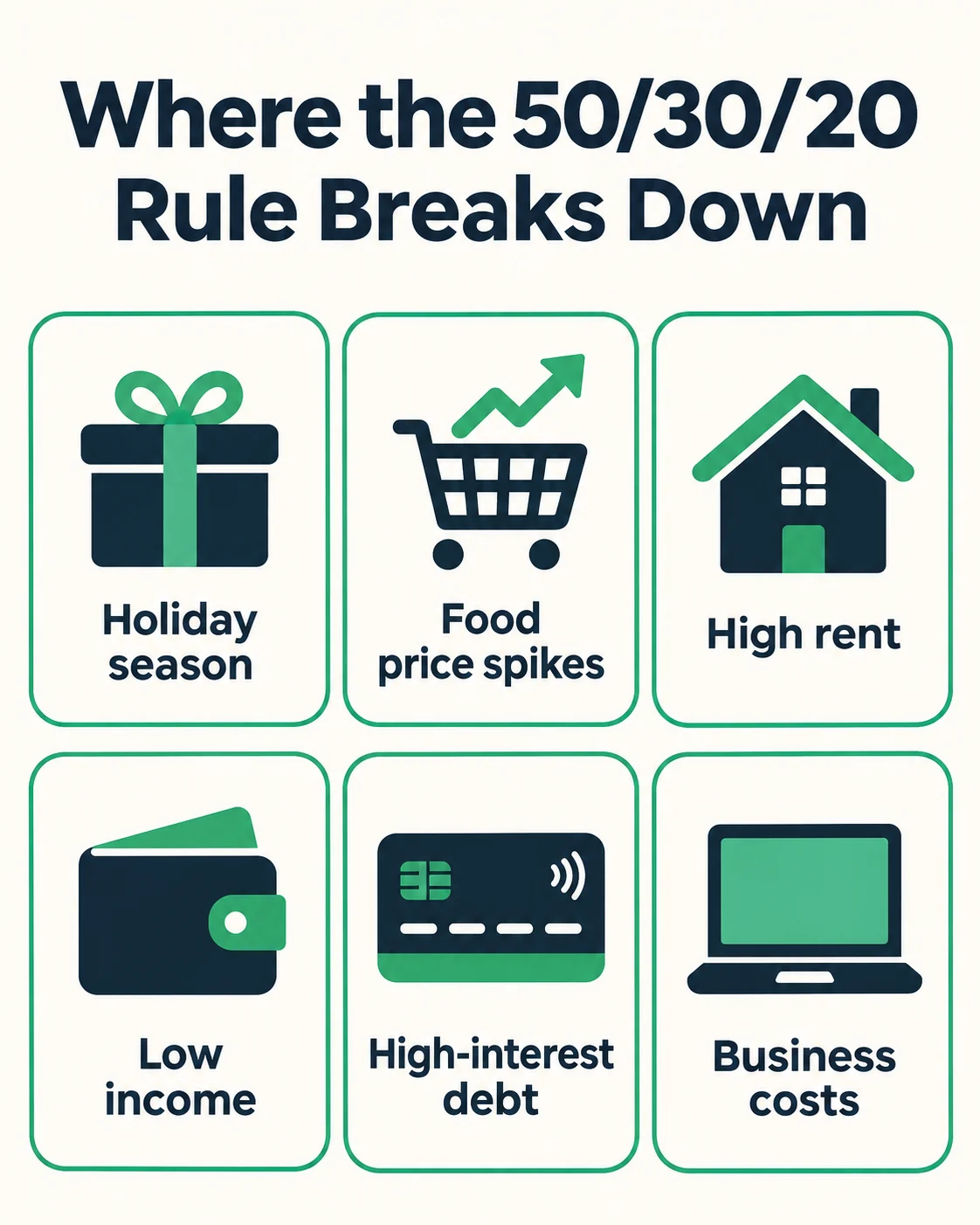
Where the 50/30/20 Rule Breaks Down
The 50/30/20 rule is a starting point, not a law. It assumes your needs fit into half your income, your income is steady and your spending is roughly the same every month. Real life doesn’t always cooperate.
Here are the places it broke for me, and the places it breaks for many other people.
1. Holiday and festival season
This is where my wants bucket overflows every year. Gifts, celebrations, travel to see family, decorations and events all pile into the same few weeks. The 30% that works fine in March doesn’t stand a chance in December.
I’m not alone. The National Retail Federation forecast that U.S. holiday sales in November and December 2026 would grow 4.2% to about $1.013 trillion. In NRF’s October survey, 56% of shoppers said the economy would affect their holiday spending, and cutting back on other spending was the most popular way they planned to cover the costs.
The fix: Treat the holidays as a planned expense, not a surprise. Set aside a small amount every month in a holiday sinking fund, so December is paid for before it arrives. It’s the same idea I use for travel.
If cash helps you stay on track, keep holiday money physically apart from everyday spending with cash envelopes or a budget binder with zipper pockets. When the envelope is empty, the holiday budget is done.
The math is friendlier than it looks. In NRF’s 2025 holiday survey, shoppers planned to spend about $890 per person on gifts, food, decorations and other seasonal items. Spread across 12 months, that’s roughly $75 a month. Taken from your wants bucket all year, it barely shows. Taken from one December paycheck, it can wreck the whole month.
2. Food price spikes
Groceries are a need, and when grocery prices jump, the needs bucket can go over 50% without you changing anything about how you live. I’ve had months where the same shopping list simply cost more.
The USDA’s Economic Research Service forecasts all food prices to rise about 2.9% in 2026, with grocery prices up 2.4% and restaurant prices up 3.5%. Some categories, like beef, fresh vegetables, sugar and sweets, are expected to rise faster than average.
The fix: Keep a small cushion in your grocery line instead of budgeting to the exact dollar. When prices rise, plan meals around cheaper staples and cut restaurant spending from the wants bucket first.
3. High rent and cost of living
For many renters, needs simply can’t fit into 50%. According to Harvard’s Joint Center for Housing Studies, a record 22.7 million renter households, about 49% of all renters, spent more than 30% of their income on rent and utilities in 2024. Some 12.1 million spent more than half.
If rent alone takes 40% or 50% of your take-home pay, the 50/30/20 rule isn’t realistic. That doesn’t mean budgeting is pointless. It means the split has to change.
4. Low income
On a small income, needs often take 70% or more. Telling someone to save 20% when they can barely cover groceries isn’t helpful. In this case, the goal is to save something every month, even if it’s 5%, and grow that number as income grows.
5. High-interest debt
If you carry credit card debt, every month of interest makes your goals harder. Many people choose to send most of their 20% toward high-interest debt after building a small starter emergency fund. Some even borrow from the wants bucket to pay it off faster.
6. Business costs for creators and freelancers
The original rule doesn’t say where business expenses go. If you blog, freelance or sell digital products, your tools, hosting, ads and software aren’t personal wants. They’re the cost of earning your income.
Keep them out of the personal 50/30/20 split completely. Take business costs out of your business income first, then apply 50/30/20 to what’s left. Otherwise, your “wants” look huge when they’re really investments.
How to Adjust It: Better Splits for Real Life
When 50/30/20 doesn’t fit, change the numbers instead of quitting. The idea behind the rule is what matters: cover needs, enjoy some of your money and always save something.
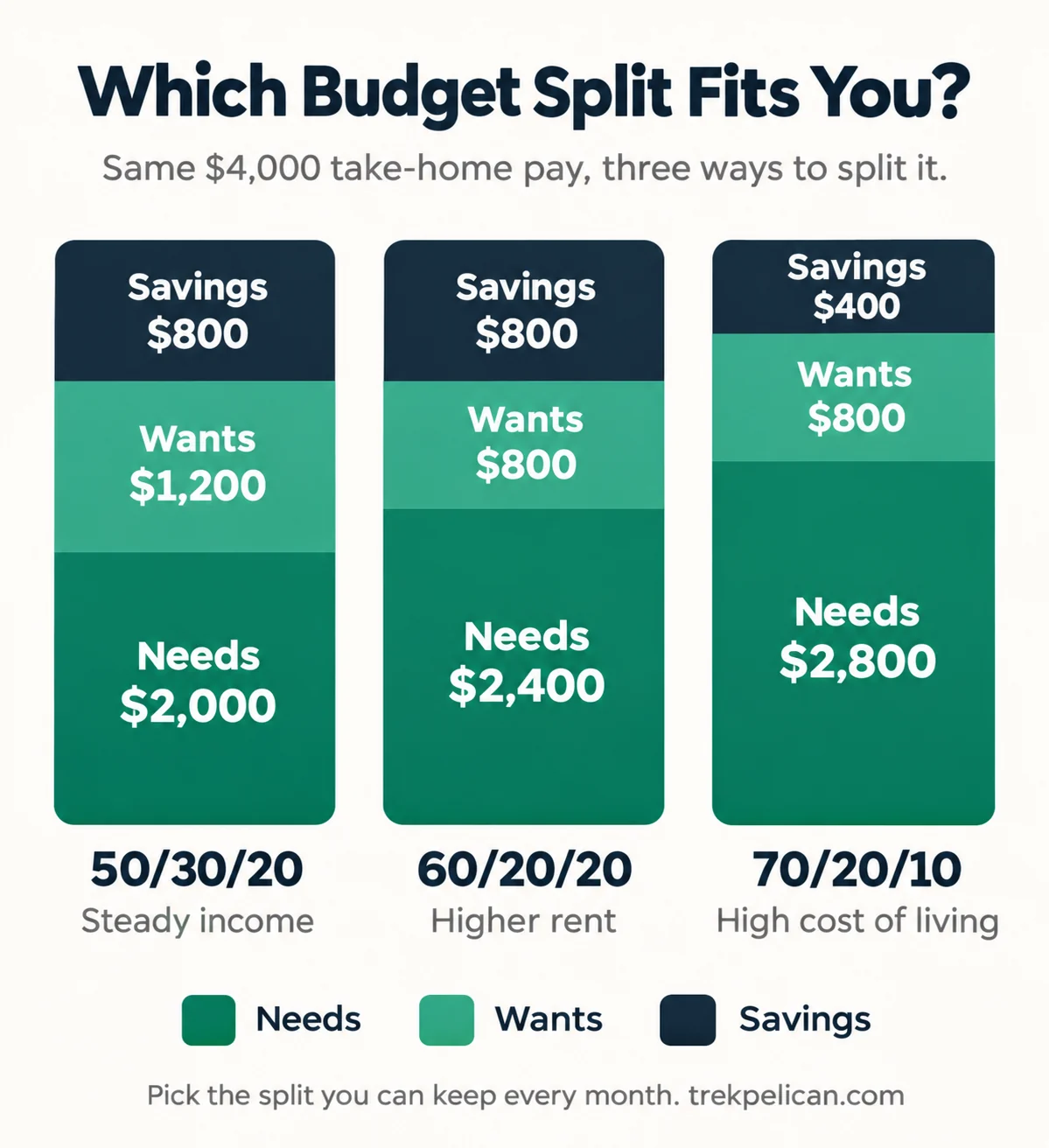
| Split | Needs / Wants / Savings | Best for |
|---|---|---|
| 50/30/20 | 50% / 30% / 20% | Steady income, average cost of living |
| 60/20/20 | 60% / 20% / 20% | Higher rent, but still serious about saving |
| 70/20/10 | 70% / 20% / 10% | Expensive cities or lower incomes |
| 80/20 | 80% spending / 20% savings | People who hate tracking categories |
| 50/20/30 | 50% / 20% / 30% | Paying off debt or saving for a big goal fast |
How to choose your split
Start with your real needs. Add up rent, groceries, utilities, transport, insurance and minimum debt payments, then divide by your take-home pay. That percentage is your needs number, whatever it is.
Next, decide how much you can save consistently, even in a tight month. Whatever is left becomes your wants bucket. Review it every few months, and move the split back toward 50/30/20 when your income grows or a big bill goes away.
I take home $2,500 a month
If your needs are closer to $1,750, try 70/20/10: $1,750 needs, $500 wants and $250 savings.
I take home $3,000 a month
If rent pushes your needs to $1,800, try 60/20/20: $1,800 needs, $600 wants and $600 savings.
I take home $4,000 a month
That’s the example month in this post. At this pace, you’d save $9,600 a year.
I take home $5,000 a month
On a higher income, consider saving more than 20% before your wants grow to match your pay.
Common 50/30/20 Mistakes
Budgeting from your gross salary
Always start from take-home pay. Gross numbers make every bucket look bigger than it is.
Calling every want a need
Premium phone plans, takeout and streaming services feel essential, but they aren’t. Split mixed expenses into their need and want parts.
Saving whatever is left at the end of the month
There’s rarely anything left. Move your savings first, the day money arrives, and live on the rest.
Ignoring seasonal costs
Holidays, birthdays, annual subscriptions and back-to-school costs come every year. Spread them across the year with small monthly amounts instead of letting them wreck one month.
Never reviewing the split
Your income, rent and goals change. Check your percentages every few months and adjust them on purpose.
Giving up after one bad month
A month where needs hit 60% isn’t failure. It’s information. Look at what pushed the number up and plan for it next time.
Start Your 50/30/20 Budget This Month
You can set this up in under an hour. Here’s the simple version:
1. Find your monthly take-home pay. Use your actual deposits. If your income varies, use a slow month.
2. List your needs. Add them up and see what percentage of your income they take.
3. Pick your split. Start with 50/30/20, or choose 60/20/20 or 70/20/10 if your needs are higher.
4. Move your savings first. Set up an automatic transfer or a payday reminder.
5. Give your wants a limit. Spend freely inside it without guilt.
6. Review at month-end. Compare plan vs. actual, then adjust next month’s plan before it starts.
Get the Free 50/30/20 Monthly Budget Planner
Plan your split, track needs, wants and savings, and review each month in one simple fillable PDF. It includes a seasonal costs page for holidays and price spikes, plus a 12-month summary. Free, with no signup needed.
Download the Free Planner →Frequently Asked Questions
Is the 50/30/20 rule still realistic?
For many people with steady income and moderate housing costs, yes. For people with high rent or low income, it’s better used as a starting point. A split like 60/20/20 or 70/20/10 keeps the same idea while fitting real costs.
Is the 50/30/20 rule based on gross or net income?
It’s based on after-tax, take-home income. If your employer deducts retirement contributions before you’re paid, you can count those toward your 20% savings.
Where does debt go in the 50/30/20 budget?
Minimum payments go in needs, because you must pay them. Any extra payments above the minimum go in the 20% savings and goals bucket.
What if my needs are more than 50%?
That’s common, especially with high rent. Lower your wants percentage first and keep saving something every month. Then look for ways to bring needs down over time, like a cheaper phone plan or meal planning.
Does the 50/30/20 rule work for students?
Yes, with adjustments. Students often have small incomes and fixed costs, so saving 20% may not be possible. Start with your most important need, like food, then save any amount you can, even if it’s small.
Plan the Holidays Without Breaking Your Budget
Holiday season is where the 30% wants bucket breaks for most people. The Holiday-Proof Money Planner helps you set a holiday budget, plan gifts and events, and track spending so December doesn’t wreck your 50/30/20 split.
Get the Holiday-Proof Money Planner →Three Numbers, One Habit
The 50/30/20 rule isn’t perfect, and it doesn’t need to be. Its job is to give every dollar a direction before the month starts. When it stops fitting, change the numbers, not the habit.
Plan the month ahead, move your savings first and look honestly at your needs. Do that consistently, and the exact percentages matter much less than you think.
If you want more ways to earn and keep more of your money, my list of passive income ideas is a good next read. And follow Trek Pelican on Pinterest so you don’t miss upcoming budgeting posts.
Sources
• Elizabeth Warren and Amelia Warren Tyagi, All Your Worth: The Ultimate Lifetime Money Plan (2005), summarized by SoFi
• National Retail Federation, NRF Forecasts 2026 Holiday Sales Growth as Consumers Remain Resilient (October 2026)
• National Retail Federation, Consumers remain the bright spot heading into the holidays (October 2026)
• National Retail Federation, How holiday shoppers plan to manage costs (November 2026)
• USDA Economic Research Service food price outlook, reported by RFD-TV (2026)
• Harvard Joint Center for Housing Studies, America’s Rental Housing 2026